
Keyword Generation
Navigation
Summary
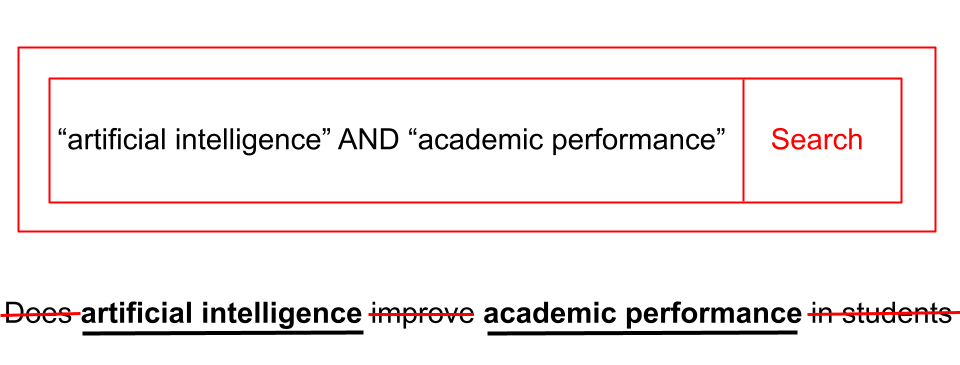
Keyword generation is the process of selecting relevant terms or phrases to guide your search for sources. It’s usage helps:
- Narrow and refine searches to find relevant information.
- Expand searches by using synonyms and related terms.
- Save time by filtering out irrelevant results.
- Optimize database searches for better results.
- Refine your research questions for a clearer focus.
Learning Outcomes
- Review strategies for keyword generation in engineering and research
- Evaluate the usage of boolean expressions to perform information retrieval.
Reference: [1]
Boolean Operators
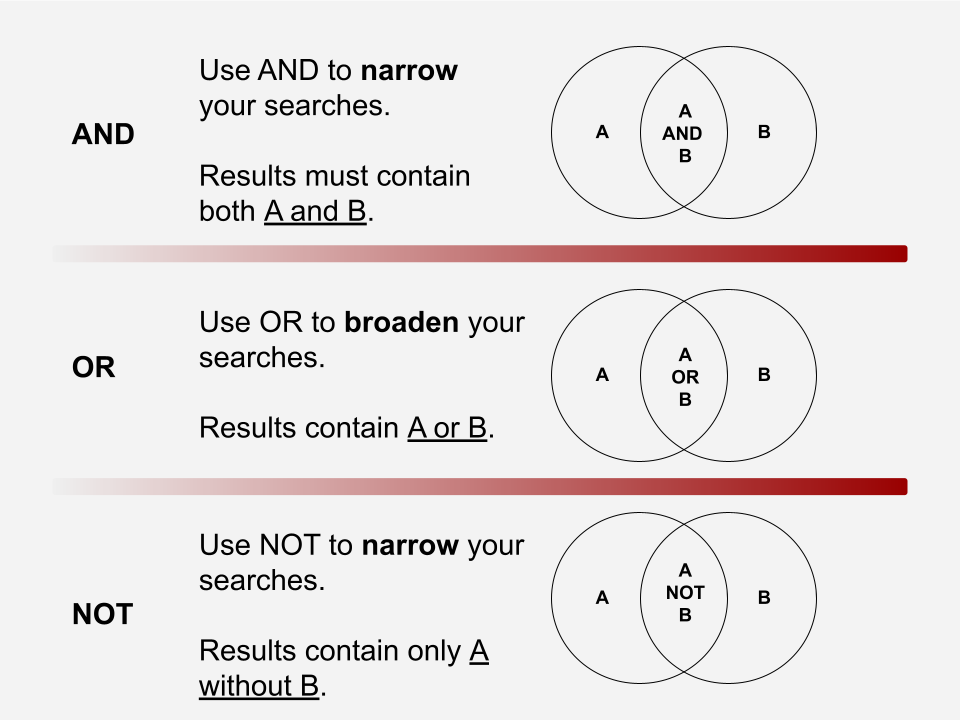
Boolean operators are logical tools (AND, OR, NOT) used to combine or exclude keywords in searches, making them highly relevant for database queries. This precision saves time and ensures more relevant and accurate results when searching for information.
Reference: [2]
Using Databases Effectively
Summary
Databases are organized collections of information such as scholarly articles, technical reports, patents, and industry standards. In research and engineering, databases are essential for efficient information retrieval, enabling users to quickly locate relevant, high-quality sources. They support advanced search functionalities—such as keyword, author, and subject filtering—helping researchers find specific information within vast collections. Databases are useful because they centralize access to trusted sources, save time in the research process, and provide comprehensive coverage of current and historical developments. This makes them critical tools for staying updated on advancements, supporting innovation, and ensuring research rigor.
Learning Outcomes
- Identify databases available for information retrieval in engineering
- Outline the importance of curated repositories and information sources
Reference: [3]
How can you trust information?
The simple answer is that “you can’t”. However, there are steps you can take to ensure you are using quality knowledge or material.
- Search for sources with at least five independant references
- Search for sources with independant verification
- Be Skeptical
For more information read this chapter on investigating resources: LibreText
North Carolina State University Database
Link to NC State Libraries Databases
- If you know exactly what database you want to use, find it using the search bar at the top of the page
- If you’re not sure what database you want to use, select the most relevant subject in the Browse Databases by Discipline list, to see that subject’s database page (i.e.: here’s what the Electrical and Computer Engineering Database page looks like)
- If you need a specific kind of source for a project (like a data set, a newspaper article, government document, etc.), look at our Database Features list, to find databases that have that specific type of information in them.
Reference: [4]
References
[1] NC State University Libraries. Keywords for Searching. Vimeo, April 10, 2023. https://vimeo.com/816213612 (accessed 2024-11-10).
[2] NC State University Libraries. Boolean Operators. Vimeo, June 7, 2022. https://vimeo.com/718048546 (accessed 2024-11-10).
[3] Borda, K. Using Databases Effectively. Panopto, 2023. https://ncsu.hosted.panopto.com/Panopto/Pages/Viewer.aspx?id=d72a20eb-58f8-4bfb-9e07-afbd0104596e&start=0 (accessed 2024-11-10).
[4] NC State University Libraries. Getting to Article Databases. Vimeo, January 31, 2022. https://vimeo.com/671974465 (accessed 2024-11-10).