
Overview
Summary
A literature review is a structured summary and analysis of prior research and technical developments relevant to a specific engineering problem. It compiles findings from scholarly articles, technical reports, patents, and industry standards, organized to reveal key advancements, methodologies, and results. The significance of a literature review lies in its role as a basis for innovation; it highlights current knowledge, identifies technological gaps, and informs design considerations for new projects. Its purpose is to contextualize engineering challenges within the broader field, justify the necessity of further development, and refine research objectives by outlining the limitations and opportunities in existing engineering solutions.
Learning Outcomes
- Explain the purpose and significance of a literature review in the context of engineering research.
- Identify the key elements of a literature review, including the purpose, historical development, key contributors, and existing knowledge gaps.
- Develop a systematic approach to conducting a literature review.
- Analyze and synthesize information from key and fringe papers to address contradictions, correlations, and gaps in the literature
What is a Literature Review?
The goal of a literature review is to provide an overview of existing research or knowledge on a specific topic. It often contextualizes a problem, identifies gaps in literature, and draws conclusions from research. Literature reviews are commonly found in research papers, theses, dissertations, and academic articles.
Reference: [1]

The Literature Review Process
The literature review process is iterative. The process involves systematically gathering and analyzing existing research on a specific topic.The scheme is a simplified representation of the actual process. As your understanding of the topic increases, your material may be reworked several times.
Reference: [2]
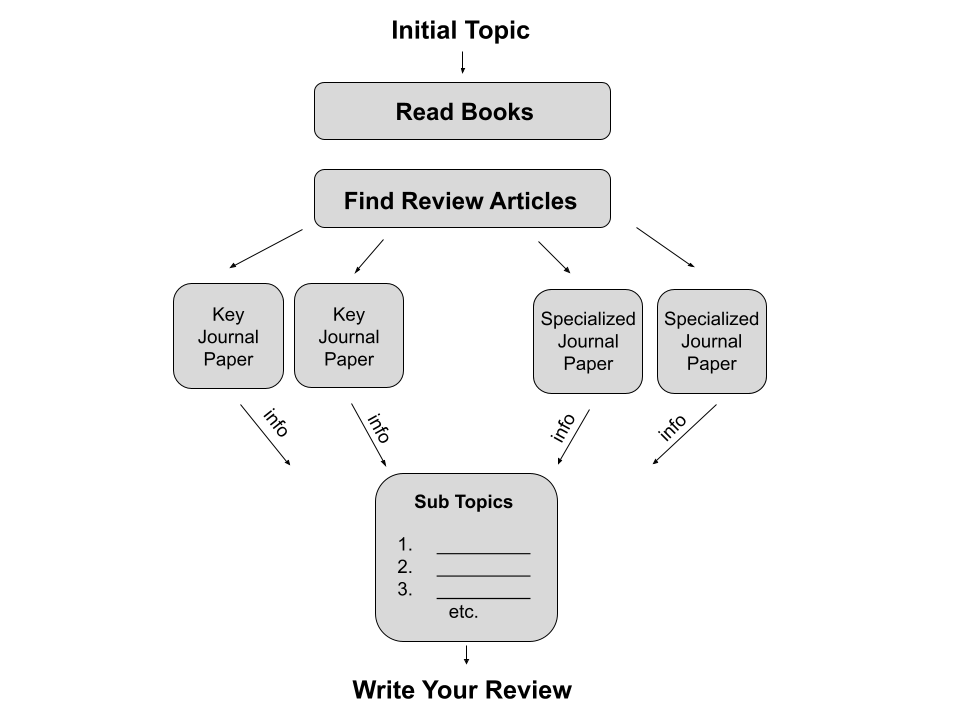
Reference: [3]
Analyzing Literature
Approach when Analyzing Literature
1. First Read the Abstract
- From the abstract you can establish the paper’s relative relevance to your needs
- Establish what parts of the paper you will need to read.
2. Read the Relevant Part of the Paper
- Skim read the rest of the article in order to find additional relevant information.
3. Annotate the Article
- Most people’s memories are far from perfect, and explanatory notes that you made at the time of reading will often not make sense when you come back to them later on. There is always something that you will have overlooked, distorted or oversimplified.
4. Classify Key Findings
- Categorize your sources based on information, discussion points, keywords, or other logical organization.
Reference: [4]
If you find an article difficult to understand, set it aside and come back to it.
There are two reasons why you may be finding it difficult:
- Your understanding of the topic is not yet sufficient. Later in the process you may be able to understand it with no difficulty.
- It may not be your fault that it is tricky to understand; remember that a hallmark of a good writer is the ability to explain even complex topics clearly. If the text seems muddy, it could be that the article is not well written.
Distinguishing between whether your understanding is lacking or whether the article is poorly written at this early stage can be difficult. Keep the paper and come back to it later.
Reference: [5]
References
[1] NC State University Libraries. What is a Literature Review? Vimeo, June 17, 2024. https://vimeo.com/960421280 (accessed 2024-11-10).
[2] Leonard, M. The Literature Review Process. Panopto. https://ncsu.hosted.panopto.com/Panopto/Pages/Viewer.aspx?id=1f8801f6-aa72-4f77-b93f-ad75011879e5&start=0 (accessed 2024-11-10).
[3] Adapted from Silyn-Roberts, H. 4 – A Literature Review. In Writing for Science and Engineering, 2nd ed.; Elsevier, 2013; pp 63-73. DOI: 10.1016/B978-0-08-098285-4.00004-2
[4] Hewett, C. Reading, annotating, and synthesizing literature. Panopto. https://ncsu.hosted.panopto.com/Panopto/Pages/Viewer.aspx?id=481df6a2-94db-4c9e-9a4c-ad3301187900&start=0 (accessed 2024-11-10).
[5] Adapted from Silyn-Roberts, H. 4 – A Literature Review. In Writing for Science and Engineering, 2nd ed.; Elsevier, 2013; pp 63-73. DOI: 10.1016/B978-0-08-098285-4.00004-2