
Journal Articles
Summary
A journal article presents original research, reviews existing studies, or provides a critical analysis on a specific topic. Journal articles provide reliable, peer-reviewed information, offer insights into the latest research, and help advance knowledge in a specific field.
Learning Outcomes
- Identify and explain the key structural elements of a journal article, including Title, Abstract, Introduction, Methods, Results, and Discussion, to facilitate effective comprehension of research papers.
- Analyze the purpose of each section in a journal article, focusing on how different components contribute to addressing an engineering problem.
- Summarize the findings of a journal article and articulate their implications for solving specific engineering problems, demonstrating an ability to synthesize information from complex research papers.
Journal Article Structure
| Section | Purpose in Journal Article |
| Title | To adequately describe the contents of the document in the fewest possible words. A rule of thumb is that titles should not contain more than 16 words and no acronyms. |
| Running Title | The short title required by journals for the tops of the pages. Running titles can use abbreviations. |
| Authors and Affiliations | To show the people who did the work presented in the paper, theinstitutions where it was done and, if necessary, the presentaddresses of the authors. |
| Abstract | To give the reader a brief overview of all of the key information inthe paper: objective, methods, results, conclusions. |
| Keywords | This is a short list of words relevant to your work that will be used by electronic services. |
| Introduction | To clearly state the purpose of the study.To allow readers to understand the background to and motivation of the study, without needing to consult the literature themselves.To indicate the authors who have worked or are working in this area, and to describe their chief contributions.To indicate correlations, contradictions and gaps in the knowledge, and to outline the approach you will take with respect to them.To provide a context for the later discussion of the results. |
| Materials and Methods | To describe your experimental procedures. Aim: repeatability byanother competent worker. |
| Results | To present your results but not to discuss them. |
| Discussion | To show the relationships among the observed facts that you have presented in your paper and to draw conclusions. |
| Results and Discussions | This section is a useful way of structuring the results and theirsignificance. |
| Conclusions | To give an overview of the conclusions that you have already drawn previously in the paper. |
| Recommendations | To propose a series of recommendations for action. |
| Acknowledgements | To thank the people who have given you help in your work and in the preparation of your paper. |
| List of References | A list of the works that you have cited in the text. Strongconventions govern this process. |
| Illustrations | Convey information through figures and tables. |
Reference: [1]

Patents
Summary
A patent is a certificate of legal protection granted by the government that gives an inventor exclusive rights to make, use, and sell for a period of time, typically 20 years. Patents encourage innovation by allowing inventors to benefit financially from their inventions, while also contributing to public knowledge. In exchange for these exclusive rights, the inventor must publicly disclose detailed information about the invention, enabling others to learn from and build upon it once the patent expires.
Learning Outcomes
- Identify and explain the key components of a patent, including the Title, Abstract, Claims, Specification, Drawings, and Background, and describe their relevance to engineering innovation and protection of intellectual property.
- Analyze the purpose and importance of patent claims in defining the scope of protection for an invention and how engineers can strategically craft claims to safeguard their innovations.
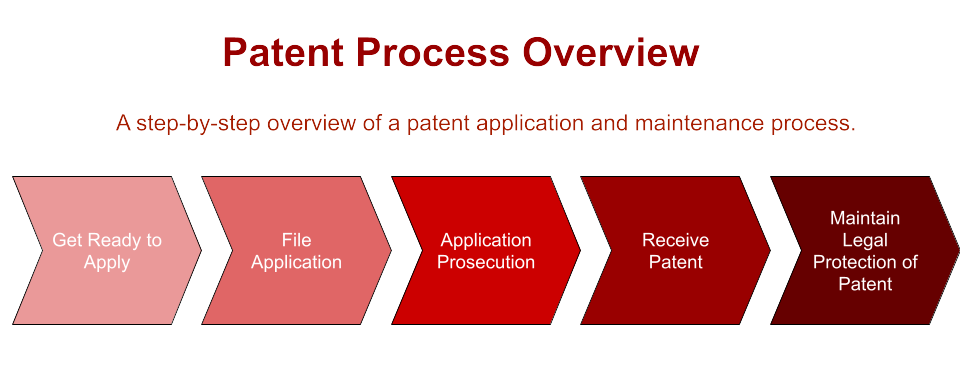
- Summarize the process of obtaining a patent, including filing, examination, and approval, and discuss how this process applies to engineering projects and entrepreneurial ventures.
Standards and Specifications
Summary
A standard is a set of guidelines or criteria established by a recognized organization to ensure consistent and reliable quality, safety, performance, or compatibility in products, services, and systems. Standards are developed based on industry best practices and expert input in order to promote efficiency, interoperability, and innovation.
Learning Outcomes
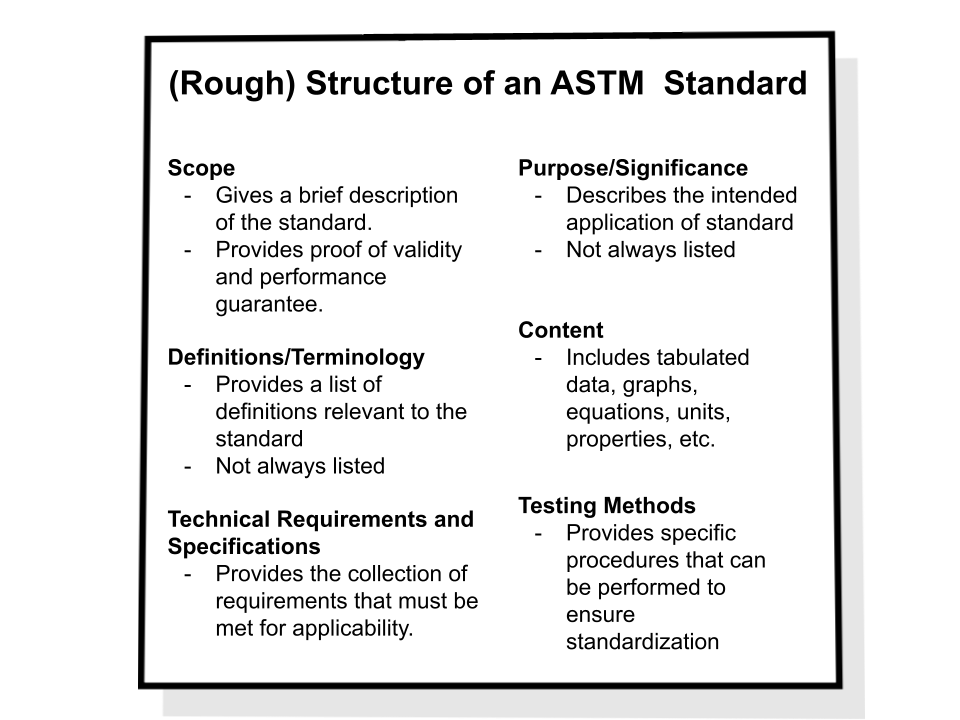
- Describe the structure and components of a standard, including the Scope, definitions, technical requirements, and testing methods.
- Explain the purpose of standards in engineering practice, related to quality, safety, and interoperability in engineering projects.
- Locate and interpret relevant standards for specific engineering problems, by evaluating their availability, access, and possible applications.
Purposes of a Standard
- Quality Control: Ensures products or services meet minimum requirements.
- Safety: Reduces risks for consumers, workers, and the environment.
- Interoperability: Facilitates compatibility between products, systems, and technologies.
- Innovation: Encourages best practices and supports advancements in technology.
- Trade: Enables smoother transactions across regions by ensuring uniform quality levels.
Popular Standards Organizations
- ASTM International (formerly American Society for Testing and Materials) – Develops standards for materials, products, systems, and services across various industries.
- ISO (International Organization for Standardization) – A global body that sets international standards across numerous industries.
- IEC (International Electrotechnical Commission) – Focuses on standards for electrical, electronic, and related technologies.
- IEEE (Institute of Electrical and Electronics Engineers) – Specializes in electrical and electronic standards, particularly in the fields of computer science and telecommunications.
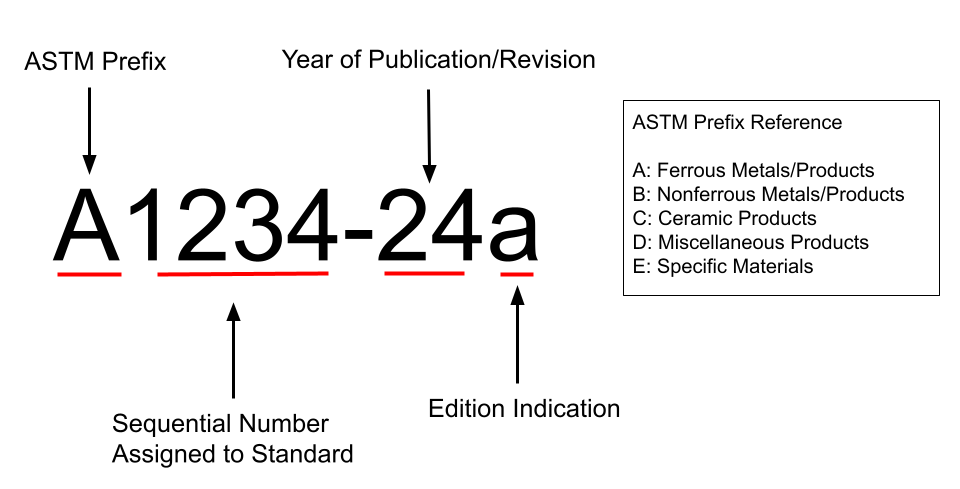
ASTM Standard Identification
Reference: [5]
Technical Reports
Summary
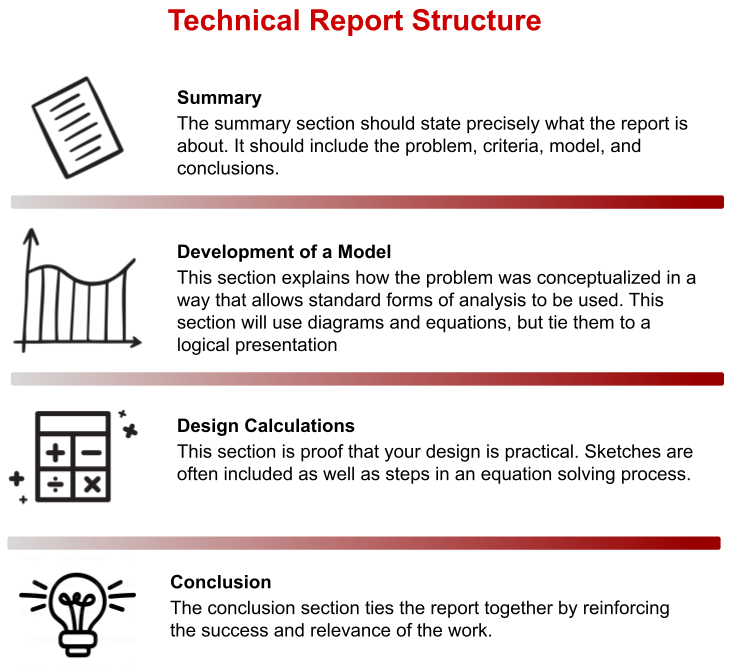
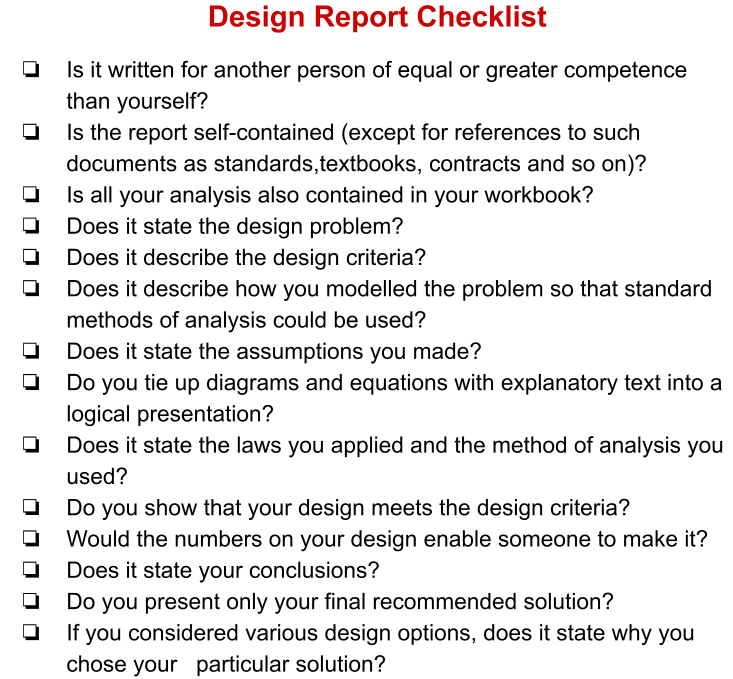
An engineering design report is a document that outlines the process and results of designing a solution to a specific engineering problem. Sections typically included are: summary, development of a model, design calculations, and conclusions. The purpose of the report is to communicate the design process and outcomes to stakeholders, such as clients, supervisors, or colleagues.
The significance of an engineering design report lies in its ability to demonstrate the rigor, creativity, and practicality of the engineering solution. It serves as a record of the design choices made, ensuring transparency and accountability. Technical reports are essential for both documenting progress and providing a basis for future improvements or iterations of the design.
Learning Outcomes
- Explain the purpose and significance of engineering design reports.
- Identify the essential sections of a design report, including the summary, development of a model, design calculations, and conclusions, and explain the function of each section.
- Apply relevant standards and technical documentation principles (e.g., ASTM, ISO) to ensure clarity and completeness in technical reports.
- Use checklists and guidelines to evaluate the completeness and accuracy of a technical report.
Reference: [6]
References
[1] Adapted from Heather Silyn-Roberts. 6 – A Journal Paper. In Writing for Science and Engineering, 2nd ed.; Elsevier, 2013; pp 83-109. DOI: 10.1016/B978-0-08-098285-4.00006-6
[2] Extracted from NC State University Libraries. Smarter than the Filter: Finding the Research Article Among the Imposters. Vimeo, October 26,2021. https://vimeo.com/639107094 (accessed 2024-11-03).
[3] Adapted from Patent process overview. USPTO. https://www.uspto.gov/patents/basics/patent-process-overview#step1.
[4] Extracted from Tourino, G. Patent Resources Presentation. Panopto. https://ncsu.hosted.panopto.com/Panopto/Pages/Viewer.aspx?id=fe37552d-91f0-4425-98ae-ad7501321098&start=0 (accessed 2024-11-03).
[5] Extracted from Hewett, C. What are Standards and Specifications? Panopto. https://ncsu.hosted.panopto.com/Panopto/Pages/Viewer.aspx?id=9374aeec-d556-4913-a8aa-ad4b0146c942&start=0 (accessed 2024-11-03).
[6] Adapted from Heather Silyn-Roberts. 9 – Engineering Design Report. In Writing for Science and Engineering, 2nd ed.; Elsevier, 2013; pp 121-124. DOI: 10.1016/B978-0-08-098285-4.00009-1