Basic Laboratory Skills – Make Up Module
Getting Oriented and Lab Unit Handout (Lab manual)

General Lab Information – Be sure to check the Lab Schedule EACH WEEK before and after Lab. As you work through activities, you should answer all questions in your digital lab manual.
Review the following on your own:
Make Up Module
Introduction to Lab 1:
- Download the Lab Unit Handouts (see links at the top of this webpage) and bring to lab on your laptop computer OR printed out on paper. Mac computers are also available in lab for your use.
- Read the following: Getting Oriented, Lab Unit 1 Basic Laboratory Skills (pp. 1-8), and Appendix A(opens in new window) before coming to the first Lab Meeting.
- Fill out and sign the Safety Statement found in Getting Oriented. A paper copy will be provided in lab for you to sign and turn into your Lab Instructor.
Make up Module
Activity One: Basic Microscopy
- Complete Activity One: Basic Microscopy (p. 1-2)
- View the following video: Microscope Basic Set up and Use
- Use the Virtual Microscope
- Click the “Learn” button to review what you learned in the Microscope video
- Click the “Explore” button to examine various slides. Start with “sample slides” and then view other slides.
- Click the “Test” button to assess your knowledge.
Activity Two: Determining Total Magnification (p. 3)
- Follow the directions in the lab handout to complete Table 1-1.
Activity Three: Determining Field of View and Cell Size (p. 3-5)
- Complete Activity Three: Determining Field of View and Cell Size.
- View the following video: Measuring with the Microscope
- Demonstrate how you would Calculate the Field of View and Cell Size for one of the Organism X example videos found at the bottom of Activity Four below. the example found in the Post-Lab. Be sure to show your work on how you set up your calculations.
- Complete Table 1-2 in your lab handout lab manual. These calculation may help you with these calculations in describing for organism in “in-Lab” and for the Post-Lab Assignment.
Activity Four: Examining Live Specimens (p. 5-8)


- You will need the knowledge/skills from Activities 1-3 (Pre-Lab and first part of the In-Lab work) to effectively carry out Activity 4. Your TA will assign you the Code (A, B, C or D) for an unknown organism to study. You may also be assigned to work with other students who missed lab this week or your TA will serve as the “other group” to supply you with additional information.
- Read the introduction to Activity 4. In the procedure, you will replace Step #2 (making your own wet mount slide) with watching an assigned video clip of an unknown microorganism, “Organism X” (see below). Start with step #3 to draw and record observations about your assigned organism on page 7. These observations are statements determined by using any one of a person’s five senses (empirical reasoning). It is typically the first step in the Scientific Method and can lead to hypotheses.
- Label all notes and drawings with date, time, and place.
- Record all results as you observe/collect them; don’t rely on memory.
- Make sure to record what you SEE, not what you THINK should be there.
- Detail is key, pay attention to even the smallest things.
- Once you have recorded your individual observations and drawing on page 7, you will compare your observations with other students in your group (if there are others). Then, as a group or on your own, you will need to write a more comprehensive description of your organism in Table 1-3 on page 8 without any sketches or diagrams. Another group (or your TA) will use your description (Table 1-3, page 9) to identify the organism based solely on your written information (no sketches or pictures) with a set of microscope images of many possible protist species.
- In turn, you will also need to ID an unknown Protist species based on a written description from another group and a set of microscope images of many possible protist species supplied by your TA. You should be prepared to defend your identification choice of the unknown organism via email with your TA (or possible office hour/Zoom meeting).
- If you cannot correctly identify the organism based on the provided description, you will need to ask the TA to edit/provide more information until you can correctly identify the unknown organism.
- Thoughtful and precise scientific communication is key to this activity and to all your laboratory work this semester. It is also vital to the peer review process – be it for class work or for publishing scientific literature.
- Organism X – Unknown Organism videos to use in place of making your own slides.
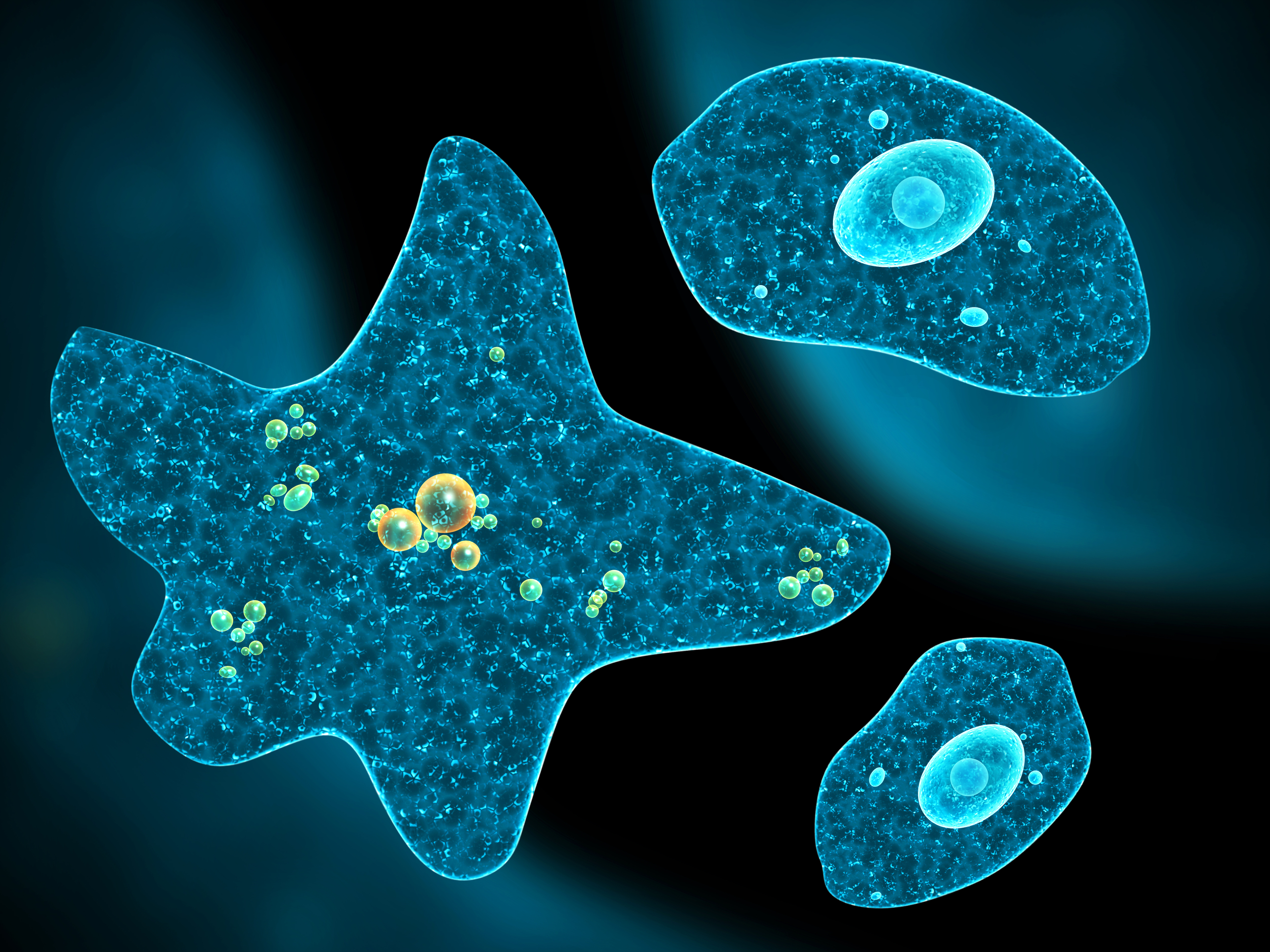
- The 4 different organisms below were filmed with a 10X ocular lens and a 10X objective lens (Videos A-D). –> The width of these microscopes videos, left to right, is the field of view. The field of view for each video is 1.4 mm (1400 µm).
For the Post Lab Unit Questions (see yellow assignment box below):
- Use Activities One to Three when answering Questions #1-4.
- For questions #4 draw/sketch from an example “slide” viewed from using the Virtual Microscope simulation to make your sketches.
- Questions #5 refers to Activity 4 – Organism X activity.
Post Lab Individual Work
Complete this attached End of Unit Questions Handout found here. Upload your work into Moodle by the End of Lab or up to 24 hours after the start of your lab section this week.
For the Online Lab Weeks students will explore BIO 181 topics outside of lab using Independent Online Learning Modules during Units 2, 2.1 and 8. Information for these modules can be found in Moodle in the indicated lab units/weeks.
Follow each of the module directions closely.
For the next In Person Lab…… Scientific Methods
Library Tutorial Assignment – Individual Work
Click this box to access the Library Tutorial. Download the Assignment Handout questions and work through the Tutorial Menu topics on the left from the same webpage. Answer all of these questions fully in your own words. Some questions refer to the linked articles, while others pertain to the WildCam Study data collected from Unit 2 in Moodle.
The Library Tutorial will help you find appropriate scientific literature to support and use in writing your WildCam Lab Report. This assignment is due by the start of your Unit 3 Scientific Methods lab. Submit your completed Library tutorial Assignment Handout in Moodle. Then you will be able to access and take the accompanying Moodle Assessment/Quiz which is also due by the start of your lab.
Introduction of the Semester Group Ecology Project
Fieldwork Sampling Safety – Important Safety points to consider with the Group Ecology Project.

Unit 4.1 Ecology Leaf Herbovory Semester Project
Click on this box to Access the Ecology Project Webpage and directions for the Fall semester – Unit 4.1 Leaf Herbivory Unit.
Benchmark #1:
You will need to collect your own Ecology data next week during your Unit 2 online week. Then after your In Person Unit 3 Lab, you will construct graphs of your own data from your 2 different trees and submit the indicated work in Moodle.
Due Friday 11:59 of your Unit 3 Week.
The Compound Light Microscope

Microscopy:
- Care and Use of Microscopes – See Appendix A on the Lab Resources webpage
- Video on How to Use a Compound Microscope
- Basic Concepts of Microscopy
- Measuring with the Microscope – how to determine the field of view and cell size
- Exploring Magnification: Power of Ten video – from 10 million light years away from the Milky Way down to 100 attometers!
- Virtual Microscope
Download FREE access to the Microsoft 365 Application (Office 365). This is free for NCSU students. We will use MS Word, Excel and PowerPoint in our labs.