Discovery and the Scientific Method
Lab Unit Handout (Lab manual -make up lab)
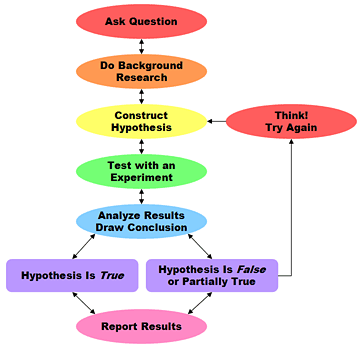
Review the following before you come to lab:
Read the Lab Unit 3 Discovery & the Scientific Method, and Appendix E Understanding and Representing data which can also be found on the Resources webpage.
Make Up Module:
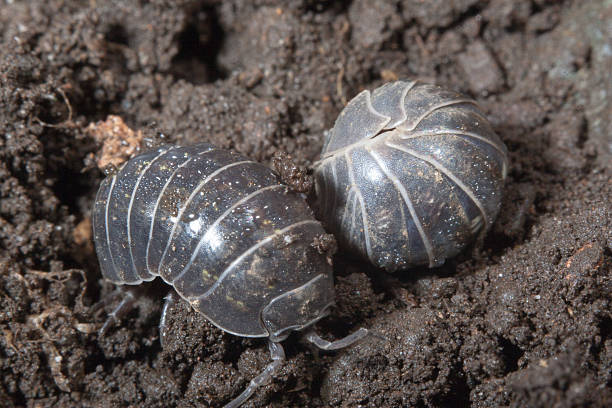

Pill bugs, left, and and Sow bug on the right, look quite similar, but careful examination will show their differences.
As you work through the activities in class, you should answer all questions/answer boxes within the Lab Handout. These will help you understand and answer the questions at the end of the lab unit.
Activity One: Designing and Conducting an Experiment
Review the background information provided in the lab handout about Pill bugs and/or Sow bugs (types of Isopods) and the provided list and pictures of available materials found below. From this information, start to think about some questions you may want to explore in your experiment and formulate a Hypothesis to record in this Experimental Design Template.
Continue planning your experiement. Be sure to fill out all the indicated fields/variables and components paying close attentions of designing a realistic (reasonable) and sound experiment. Careful planning is key to designing a good experiment.
You may email your TA asking them to provide some initial feedback on your design or you can just turn it in directly for grading in Moodle as 1 of 2 documents needed for the Unit 3: In-Lab Experimental Design and Results (graphing) assignment (5 pts total).
Experiment Materials and Supply List(opens in new window)
Below are pictures of some possible materials: (click on pictures to enlarge)
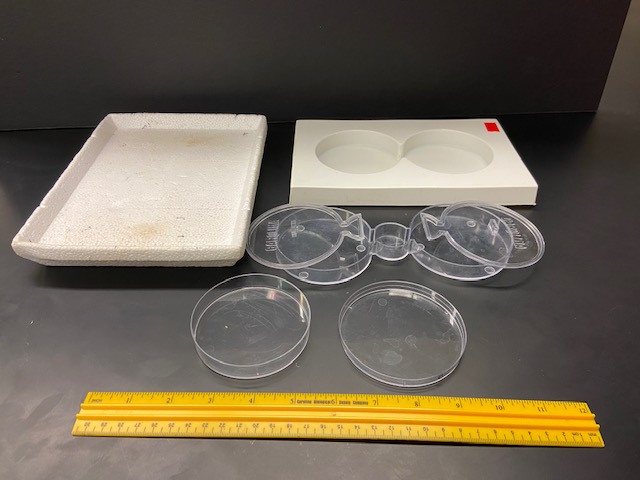
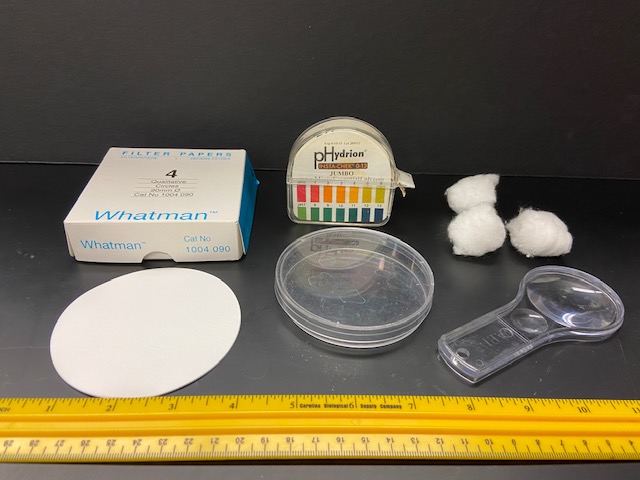

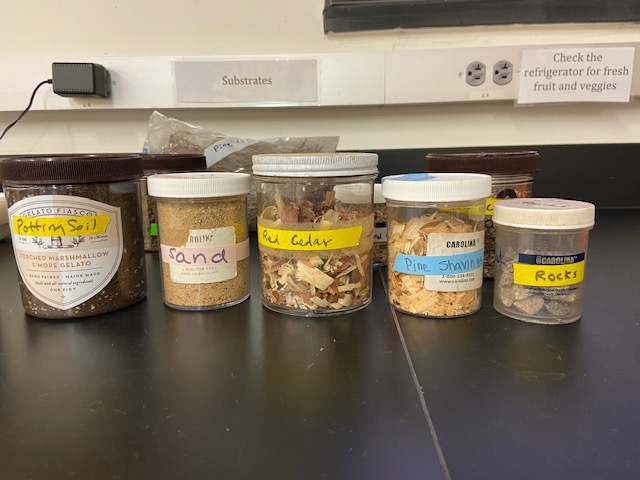


Assignment 1 – Make Up Students should design an experiment based on what is available in the pictures or list above.
Depending on your circumstances and the timing of your make up work, you may be paired back with your regular Group # table to participate in writing the group Lab Report. If your make up takes place too late to work with your group, your TA may direct you to write the whole report on your own. Be sure to speak with your TA early on to determine what is best. Your TA needs to approve your make up and will not grade any unapproved submitted make up work.
BE SURE TO DISCUSS THIS WITH YOUR TA FOR APPROVAL and what to do about First Full Draft, Final Full Draft and Peer Review.
Provided Pill Bug Experiment Data(opens in new window)
Contemplate if you will include all the provided data points or data averages when considering what type of graph would best represent/summarize the data and experiment.
To construct a proper Graph, review Lab Manual Appendix D Graphing Using Excel(opens in new window) (p. 220 for key components), Appendix E Understanding and Representing Data(opens in new window) or LabWrite – Resources – Data Representations shows examples of Data Types, Tables and Various Types of Graphs. Graphs should be produced using a graphing program, such as Excel or Google Sheets. NCSU Student can download Microsoft Office 365 from NC State’s OIT software site) for free.
Turn in your completed fully labeled graph of the provided data to your TA.
Your TA may ask you to present your Experimental Design and graph to your TA once you are back in class.
Post Lab Individual Work
Complete this attached End of Unit Questions Handout found here for the Make Up Lab Handout above. Upload your work into Moodle by the End of Lab or up to 24 hours after the start of your lab section this week.
Group Work Contract
Complete the attached template as a group. This contract will serve as guidelines for all your graded group work in lab.
Leave a copy of this in your Google Group Work folder and turn it in on Moodle by Friday 11:59PM of this in Person Lab Week.
Only 1 person will need to submit this for the group
Ecology Group Work Week 1
Click to access the Unit 4.1 Benchmark #2 webpage
Read the Benchmark #2 directions on what to do and submit concerning your COMBINED GROUP data.
Benchmark #2 is due by Friday 11:59PM of the Ecology Work Week 1.
WildCam Lab Report – Group Work
Use the LabWrite website to write a Full Lab Report using data from your Unit 2 completed lab group WildCam assignments. Groups should use and cite at least one primary and one secondary reference in their text and provide a properly formatted CSE Reference section (Refer to the links in “Writing Lab Reports” below). References are generally introduced in the Introduction & further used in the Discussion. Click this box for further details.
Please complete ALL written group work in your Lab Google drive folder to optimize access and contributions from everyone. Directions will be provided in your Lab Google folder.
1. This Group writing assignment is due by Friday 11:59PM of your Ecology Project Work Week 1. This provides your group ample time to write the First Draft Full Lab Report and submit it in Moodle. The group should also complete the provided Lab Report Rubric adding comments and grading each section of their own report.
2. Quick feedback will be provided by the TA to ensure proper formatting, depth and use of citations.
3. The Final WildCam Lab Report is due Unit 5 by the Friday 11:59PM Moodle.
4. There will also be an individual Peer Group Work Evaluation due with the final Lab Report. See information below.
Please complete ALL written group work in your Lab Google drive folder to optimize access and contributions from everyone. Directions will be provided in your Lab Google folder.
If AI is used to help write this report, be sure to follow and include all steps in the guidelines for “Using AI…” link below.
Lab Report Rubric – use for guidance in writing the Lab Report AND also for peer reviewing your groups assigned paper.
Individual Peer Group Work Evaluation – (Discuss with your TA for Make Up work)
- Each student will use the provided form to rate themselves and their group members on their contributions to this group written Lab Report.
- Each student must also list their own contributes on each part of the process in the Notes column. Adding notes about other group members can also be added.
- This form is only submitted on Moodle to share with the TA.
- It must be submitted by the due date (same as the final Lab Report) to be eligible for a possible 5 pts.
Writing Lab Reports
- Inside-Out-Approach to writing lab reports
- LabWrite Home
- LabWrite – PostLab: Writing your Lab Report – follow the directions on this webpage. This approach will guide you through the whole process of writing a full lab report so that your work is fully synthesized. Visit all the internal prompts/links as needed.
- LabWrite – Resources – Data Representations(opens in new window) – showings examples of Data Types, Tables and Various Types of Graphs
- Lab Report Rubric
- Guide to Analyzing Sections of a Lab Report — Pretend you are grading your report. How did you do
- PPT that shows common mistakes with plagiarism
- PowerPoint from a Workshop on Writing Lab Reports
- (PPT tells you the basics, but also addresses common mistakes and questions from past students.)
- Writing tips for Scientific Writing (Active/Passive Voice, Wordiness, References, Pronouns, Tense Issues, Syntax)
- Sample Lab Reports –Look at formatting AND how references are used and cited.
- View a Sample Scientific Journal Article – Honey Bee Article – – Lab Reports use the same format as primary literature and are great practice for reading, writing and understanding primary literature.
Using AI Generative Text to Write Lab Reports
Use this information if you decide to use an AI Generative Text source such as ChapGPT. Be sure to follow all of the steps and include the citation and reflection piece into your final Lab Report document.
Finding and Citing References in your Lab Report
- Check out the Resources page on the main Lab homepage to help with writing in-text citations and full references.
- 8th Edition CSE Scientific Style and Format Citation Quick Guide
Additional help outside of the Biology Department and your TA
The Scientific Process
Graphing Resources
- Appendix D – Graphing Using Excel
- Appendix E – Understanding and Representing Dat
Sample Scientific Papers
Sample Scientific Papers – Primary vs. Secondary literature
- Is your paper Primary and Secondary literature? How can you tell?
- How well did the paper follow Lab Report/Scientific literature structure? Did anything seem odd or different for you? Does this change your idea of Primary or Secondary Literature? Why or why not?
Oral Scientific Communications: Presentations
This week Groups will compile an abbreviated presentation using a provided presentation template.

- Appendix C: Making Presentations(opens in new window) in your lab manual
- Organize information and PRACTICE before you present.
- Be professional in what you present (use visuals) AND in what you say.
- Your presentations should follow the same general format/sections of a scientific paper.
- Include primary literature references in your presentation.
- Be prepared to answer scientific questions related to your experimental design, results, etc.